Qualitative Analysis and Chemical Bonding Ap Review Questions Answers
What is Chemical Bonding?
Chemical Bonding refers to the formation of a chemical bail between two or more atoms, molecules, or ions to give rise to a chemical compound. These chemical bonds are what continue the atoms together in the resulting compound.
JEE Master 2021 LIVE Chemical science Paper Solutions 24-Feb Shift-ane Memory-Based

Table of Content
- Lewis Theory
- Kossel'due south Theory
- Types of Chemic Bonds
- Ionic Bond
- Lewis Structures
- Bond Characteristics
- Resonance in Chemic Bonding
- London Dispersion Forces
- FAQs
The attractive strength which holds various constituents (atom, ions, etc.) together and stabilizes them by the overall loss of free energy is known as chemical bonding. Therefore, it tin can be understood that chemical compounds are reliant on the force of the chemical bonds betwixt its constituents; The stronger the bonding between the constituents, the more stable the resulting compound would be.
The reverse besides holds true; if the chemical bonding between the constituents is weak, the resulting compound would lack stability and would easily undergo some other reaction to give a more than stable chemic compound (containing stronger bonds). To find stability, the atoms try to lose their free energy.
Whenever affair interacts with another form of thing, a forcefulness is exerted on i by the other. When the forces are attractive in nature, the energy decreases. When the forces are repulsive in nature, the energy increases. The attractive force that binds two atoms together is known every bit the chemical bond.
Important Theories on Chemic Bonding
Albrecht Kössel and Gilbert Lewis were the outset to explain the formation of chemical bonds successfully in the year 1916. They explained chemic bonding on the footing of the inertness of noble gases.
Lewis Theory of Chemic Bonding
- An atom can be viewed as a positively charged 'Kernel' (the nucleus plus the inner electrons) and the outer shell.
- The outer shell can accommodate a maximum of eight electrons merely.
- The eight electrons present in the outer shell occupy the corners of a cube which surroundings the 'Kernel'.
- The atoms having octet configuration, i.eastward. 8 electrons in the outermost beat out, thus symbolize a stable configuration.
- Atoms can achieve this stable configuration by forming chemical bonds with other atoms. This chemical bond tin can be formed either by gaining or losing an electron(s) (NaCl, MgCl2) or in some cases due to the sharing of an electron (F2).
- Only the electrons present in the outer shell, also known as the valence electrons have function in the germination of chemic bonds. Gilbert Lewis used specific notations better known as Lewis symbols to represent these valence electrons.
- Generally, the valency of an element is either equal to the number of dots in the respective Lewis symbol or eight minus the number of dots (or valence electrons).
Lewis symbols for lithium (i electron), oxygen (6 electrons), neon (8 electrons) are given below:

Hither, the number of dots that surround the respective symbol represents the number of valence electrons in that atom.
Kossel's theory of Chemical Bonding
- Noble gases separate the highly electronegative halogens and the highly electropositive alkali metals.
- Halogens tin can form negatively charged ions by gaining an electron. Whereas brine metals can grade positively charged ions by losing an electron.
- These negatively charged ions and positively charged ions have a noble gas configuration that is 8 electrons in the outermost trounce. The general electronic configuration of noble gases (except helium) is given by nstwonp6.
- As unlike charges concenter each other these unlike charged particles are held together by a strong force of electrostatic allure existing between them. For example, MgCl2, the magnesium ion, and chlorine ions are held together past strength of electrostatic allure. This kind of chemical bonding existing between two unlike charged particles is known as an electrovalent bail.
Caption of Kossel Lewis Approach
In 1916 Kossel and Lewis succeeded in giving a successful explanation based upon the concept of an electronic configuration of noble gases about why atoms combine to form molecules. Atoms of noble gases have little or no tendency to combine with each other or with atoms of other elements. This means that these atoms must be having stable electronic configurations.
Due to the stable configuration, the noble gas atoms neither have any tendency to gain or lose electrons and, therefore, their combining capacity or valency is zero. They are so inert that they even practise non form diatomic molecules and be as monoatomic gaseous atoms.
⇒ Likewise Read:
- Fajan'due south rule
- VSEPR Theory
Types of Chemical Bonds
When substances participate in chemical bonding and yield compounds, the stability of the resulting chemical compound tin be gauged by the type of chemic bonds it contains.
The blazon of chemic bonds formed vary in strength and properties. In that location are 4 chief types of chemic bonds which are formed by atoms or molecules to yield compounds. These types of chemical bonds include:
- Ionic Bonds
- Covalent Bonds
- Hydrogen Bonds
- Polar Bonds
These types of bonds in chemical bonding are formed from the loss, proceeds, or sharing of electrons between two atoms/molecules.
Ionic Bonding
Ionic bonding is a blazon of chemical bonding which involves a transfer of electrons from one atom or molecule to another. Hither, an atom loses an electron which is in plow gained by another atom. When such an electron transfer takes place, one of the atoms develops a negative charge and is now called the anion.
The other atom develops a positive charge and is called the cation. The ionic bond gains force from the deviation in accuse between the two atoms, i.e. the greater the accuse disparity between the cation and the anion, the stronger the ionic bail.
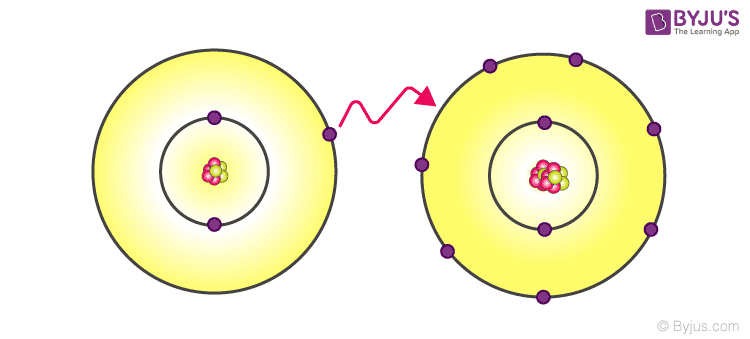
Types of Chemical Bonds – Ionic bonding
Covalent Bonding
A covalent bond indicates the sharing of electrons between atoms. Compounds that contain carbon (also called organic compounds) commonly exhibit this type of chemical bonding. The pair of electrons which are shared by the two atoms now extend effectually the nuclei of atoms, leading to the creation of a molecule.
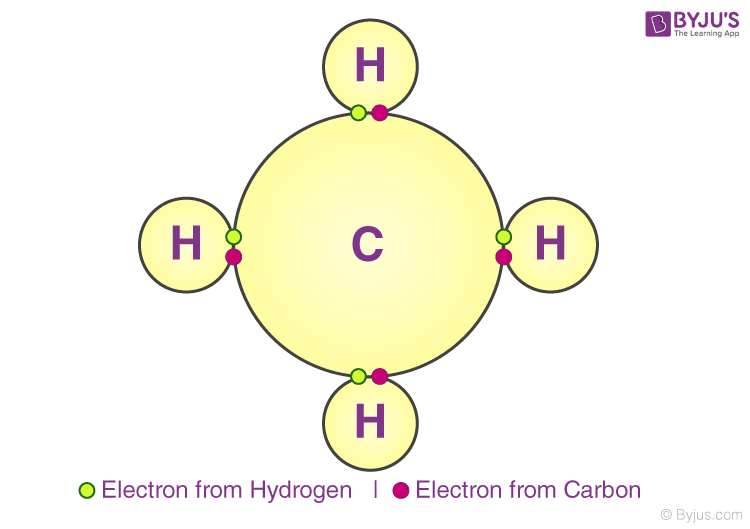
Covalent Bonding
Polar Covalent Bonding
Covalent bonds can be either be Polar or Not-Polar in nature. In Polar Covalent chemical bonding, electrons are shared unequally since the more than electronegative cantlet pulls the electron pair closer to itself and away from the less electronegative atom. Water is an example of such a polar molecule.
A difference in accuse arises in dissimilar areas of the atom due to the uneven spacing of the electrons between the atoms. One cease of the molecule tends to be partially positively charged and the other terminate tends to be partially negatively charged.
Hydrogen Bonding
Compared to ionic and covalent bonding, Hydrogen bonding is a weaker grade of chemical bonding. It is a blazon of polar covalent bonding between oxygen and hydrogen wherein the hydrogen develops a partial positive accuse. This implies that the electrons are pulled closer to the more electronegative oxygen atom.
This creates a tendency for the hydrogen to be attracted towards the negative charges of any neighbouring atom. This type of chemical bonding is chosen a hydrogen bond and is responsible for many of the properties exhibited by water.
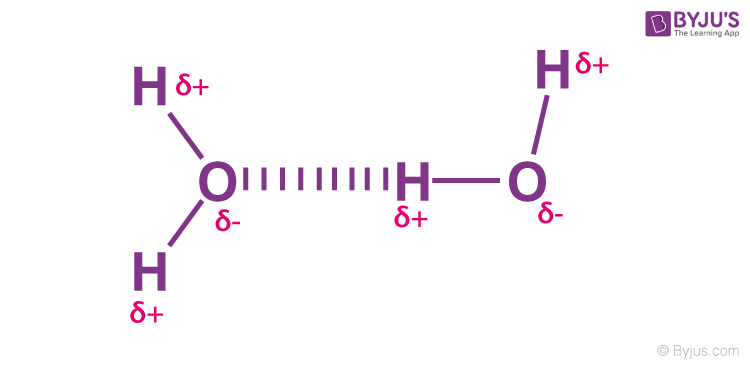
Hydrogen Bonding
What is Ionic Bond?
The bond formed equally a result of strong electrostatic forces of allure betwixt a positively and negatively charged species is called an electrovalent or ionic bail. The positively and negatively charged ions are aggregated in an ordered arrangement called the crystal lattice which is stabilized by the energy chosen the Lattice enthalpy.
Weather for the formation of an Ionic Bond
- The low ionization free energy of the atom forming the cation.
- High electron gain enthalpy of the atom forming the anion.
- High negative lattice enthalpy of the crystal formed.
More often than not, the ionic bond is formed between a metallic cation and non-metal anion.
Chemical Bonding and Molecular Structure Rapid Revision

Writing Lewis Structures
The following steps are adopted for writing the Lewis dot structures or Lewis structures:
Step 1: Calculate the number of electrons required for drawing the structure by adding the valence electrons of the combining atoms.For Example, in methane, CH4 molecule, in that location are viii valence electrons (in which 4 belongs to carbon while other iv to H atoms).
Step 2: Each negative charge i.e. for anions, we add together an electron to the valence electrons and for each positive charge i.due east. for cations we subtract 1 electron from the valence electrons.
Footstep 3: Using the chemic symbols of the combining atoms and amalgam a skeletal construction of the chemical compound, divide the total number of electrons as bonding shared pairs between the atoms in proportion to the total bonds.
Step 4: The central position in the molecule is occupied by the least electronegative atom. Hydrogen and fluorine more often than not occupy the final positions.
Step v: After distributing the shared pairs of electrons for single bonds, the remaining electron pairs are used for multiple bonds or they plant alone pairs.
The basic requirement is that each bonded atom gets an octet of electrons.
Example i: Lewis formula for carbon monoxide, CO
Step 1: Counting the full number of valence electrons of carbon and oxygen atoms: C (2s22p2) + O (2sii2p4) 4 + six = 10 that is, four(C) + vi(O) = x
Footstep 2:The skeletal construction of carbon monoxide is written every bit CO
Footstep three:Drawing a unmarried bond between C and O and completing octet on O, the remaining two electrons are solitary pair on C.

Stride iv: This does non complete the octet of carbon, and hence we have a triple bond.

Case 2: Lewis Structure of nitrite, NO2 –
Step one:Counting the total number of valence electrons of one nitrogen atom, ii oxygen atoms and the additional one negative accuse (equal to one electron). Total Number of valence electrons is: North (2s22pthree) + 2O (2s22p4) + ane (negative charge) => 5+ 2(6) +i=18e–
Stride 2: The skeletal construction of nitrite ion is written equally O-Northward-O
Step iii: Drawing a single bond between nitrogen and each oxygen cantlet: O – Due north – O
Step 4:Complete the octets of atoms.

This structure does not complete octet on N if the remaining two electrons constitute of a alone pair on it. Therefore, we take a double bond betwixt one N and one of the ii O atoms. The Lewis structure is

Problems:
- Write the Lewis structure for the following.
- COthree two- b) CN– c) And so5 two-
Bond Characteristics
Bond Length
During chemical bonding, when the atoms come up closer to each other, the attraction takes place between them and the potential energy of the system keeps on decreasing till a particular distance at which the potential free energy is minimum. If the atoms come up more than closer, repulsion starts and again the potential energy of the system begins to increase.
At equilibrium distance, the atoms keep on vibrating about their hateful position. The equilibrium distance betwixt the centres of the nuclei of the two bonded atoms is called itsBond length.
It is expressed in terms of an angstrom (A0) or picometer (pm). It is determined experimentally past x-ray diffraction or electron diffraction method or spectroscopic method. The bond length in chemical bonding is the sum of their ionic radii, in an ionic compound. In a covalent compound, information technology is the sum of their covalent radii. For a covalent molecule AB, the bail length is given by d= ra + rb
Factors Affecting the Bond length
- Size of the atoms:The bond length increases with increase in the size of the atom. HI > HBr > HCl > HF
- The multiplicity of Bond:The bond length decreases with an increase in bond order.
- Type of hybridization:A's' orbital is smaller in size, greater the 's' grapheme, shorter is the bond length.
Bond Enthalpy
When atoms come close together the energy is released due to the chemic bonding between them. The corporeality of energy required to break ane mole of bonds of a blazon so equally to divide the molecule into individual gaseous atoms is calledbail dissociation enthalpy or Bond enthalpy. Bond enthalpy is normally expressed in KJ mol-one.
Greater is the bond dissociation enthalpy, greater is the bond strength. For diatomic molecules similar Htwo, Cl2, Otwo, Due north2, HCl, HBr, Hi the bond enthalpies are equal to their dissociation enthalpy.
In the case of polyatomic molecules, bond enthalpies are unremarkably the average values, considering the dissociation energy varies with each type of bail.
In Htwo0, first O-H bond enthalpy = 502 KJ/mol; Second bail enthalpy = 427 KJ/mol Average bond enthalpy = (502 + 427) / 2 = 464.5 KJ/mol
Factors Affecting Bond Enthalpy in Chemical Bonding
Size of the Cantlet
Greater the size of the cantlet, greater is the bond length and less is the bond dissociation enthalpy i.e. less is the bond forcefulness during chemic bonding.
Multiplicity of Bonds
Greater is the multiplicity of the bail, greater is the bond dissociation enthalpy.
Number of Lone Pair of Electrons Present
More the number of solitary pair of electrons present on the bonded atoms, greater is the repulsion betwixt the atoms and thus less is the bond dissociation enthalpy of the chemical bond.
Bond Angle
A bond is formed past the overlap of atomic orbitals. The direction of overlap gives the direction of the bond. The bending betwixt the lines representing the direction of the bond i.east. the orbitals containing the bonding electrons is called the bond angle.
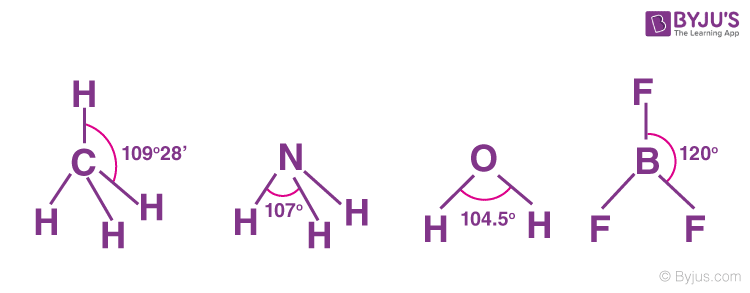
Factors Affecting Bond Enthalpy in Chemical Bonding
Bail Order
In Lewis representation, the number of bonds present between 2 atoms is called thebond order. Greater the bond guild, greater is the stability of the bond during chemical bonding i.east. greater is the bond enthalpy. Greater the bond order, shorter is the bond length.
Resonance in Chemical Bonding
There are molecules and ions for which drawing a single Lewis construction is not possible. For example, we can write two structures of O3.

In (A) the oxygen-oxygen bond on the left is a double bond and the oxygen-oxygen bond on the correct is a single bond. In B the state of affairs is only the opposite. The experiment shows, however, that the 2 bonds are identical.
Therefore neither structure A nor B can be correct. One of the bonding pairs in ozone is spread over the region of all three atoms rather than localized on a particular oxygen-oxygen bond. This delocalized bonding is a type of chemical bonding in which bonding pair of electrons are spread over a number of atoms rather than localized between two.

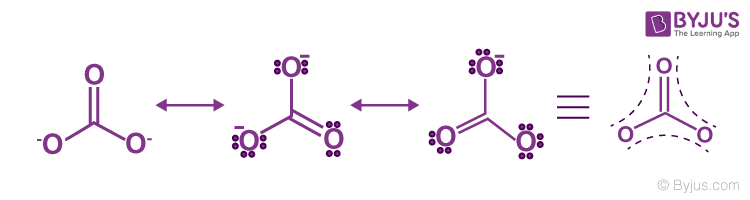
Structures (A) and (B) are chosen resonating or canonical structures and (C) is the resonance hybrid. This phenomenon is called resonance, a state of affairs in which more than one canonical structure tin can be written for a species. The chemical activity of an atom is determined by the number of electrons in its valence beat out. With the help of the concept of chemic bonding, ane can define the structure of a compound and is used in many industries for manufacturing products in which the true structure cannot exist written at all.
Some other examples:
- COthree 2– ion
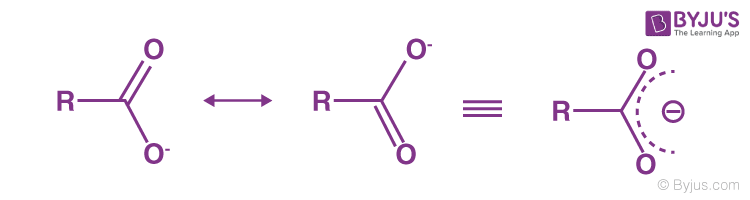
- Carbon-oxygen bail lengths in carboxylate ion are equal due to resonance.
- Benzene

- Vinyl Chloride
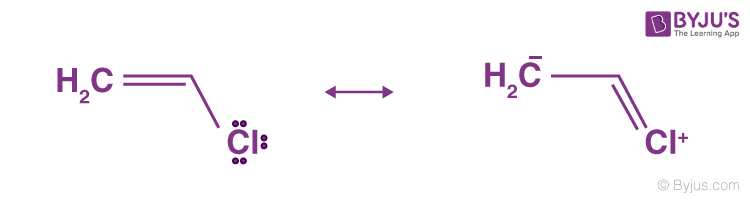
The difference in the energies of the canonical forms and resonance hybrid is called resonance stabilization energy.
London Dispersion Forces
Another form of chemic bonding is caused by London dispersion forces. These forces are weak in magnitude.
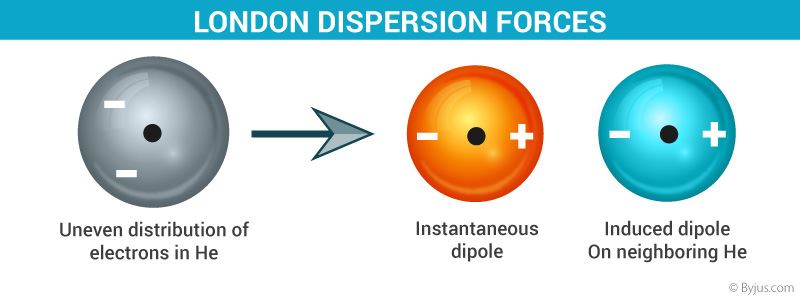
Chemic Bonding – London Dispersion Forces
These forces occur due to a temporary charge imbalance arising in an cantlet. This imbalance in the charge of the atom tin induce dipoles on neighbouring atoms. For example, the temporary positive charge on one area of an atom can attract the neighbouring negative charge.
FAQs on Chemical Bonding and Molecular Structure
Why atoms react and how?
Atoms having eight electrons in their terminal orbit are stable and have no trend to react. Atoms having less than eight electrons, then react with other atoms to get 8 electrons in their outermost orbit, and become stable. Atoms having slightly backlog than 8 electrons may lose them, to atoms, which, are curt of 8. Atoms that cannot either loss or proceeds, may share to get octet configuration. Molecules brusque of octet configuration even afterward the reaction, may accept lone pair of electrons present in other atoms or molecules.
Name the forces that go along reacting atoms together.
In metals, outer orbitals of atoms overlap and then the electrons present in them do not belong to any item atom but period over to all atoms as well and demark them all together (metallic bonding). Atoms that accept to lose and proceeds electrons, becomes ions and are held together by the electrostatic forces of allure (Ionic Bail). When atoms equally give and share electrons, the shared electrons becomes the unifying force between them (covalent bail). Electron-deficient and gratuitous lone pair containing molecules may again and satisfy the octet thirst of the electron-deficient atom. The shared electron bridges the electron-rich atom with electron-deficient cantlet (coordinate bail).
What are hybridized orbitals? What are the uses of it?
Relatively similar energy sub-orbitals may merge and course a new set of the same number of orbitals, having the holding of all the contributing orbitals in proportion to their numbers. These orbitals are hybridized orbitals. They are useful in explaining the similarity in bond length, bond angles, structure, shape and magnetic properties of molecules.
sp3 and dsp2 are iv hybridized orbitals. Merely one is the tetrahedral shape and other square planar. Why?
sp3 orbitals are formed from the s -subshell with uniform electron distribution around the nucleus and of p-subshell with distribution in the iii vertical axis. Hybridized orbitals, hence have their electron distribution in three dimensions, every bit tetrahedral directions.
In dsp2 all the orbitals involved I hybridization have their electron distribution around the same plane. Hence, the hybridized orbitals likewise are in the same plane giving rise to square planar geometry.
The oxygen molecule is paramagnetic. Is there an explanation?
Oxygen atom shares two electrons, each with another oxygen atom to form the oxygen molecule. Oxygen molecule exhibits paramagnetic nature indicating unpaired electrons. A molecular orbital theory has been proposed to explain this. Co-ordinate to this theory, atoms lose their orbitals and rather class an equal number of orbital covering the unabridged molecule and hence the name molecular orbital. Filling up of these orbitals in increasing free energy order leaves unpaired electron explaining the paramagnetic behaviour of oxygen molecule.
laycockbuiribithe.blogspot.com
Source: https://byjus.com/jee/chemical-bonding/
0 Response to "Qualitative Analysis and Chemical Bonding Ap Review Questions Answers"
Post a Comment