The Pressure Produced by 10 Feet Head of Water Is Equal to a Gauge Pressure Reading of ______ Psi
АНГЛИЙСКИЙ ДЛЯ СВАРЩИКОВ
Oxygas Cut Equipment
An oxygas cutting outfit usually consists of a cylinder of acetylene or MAPP gas, a cylinder of oxygen, ii regulators, two lengths of hose with
Oxygen cylinder valve
/ Oxygen / safety valve Torch
MAPP or acetylene с у 1 mder
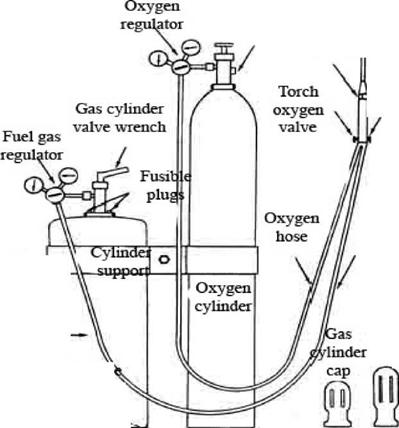
fittings, and a cutting torch with tips (figure at left). An oxygas cut outfit also is referred to as a cutting rig.
Raised
opening
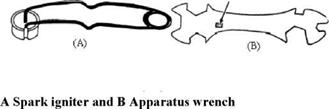
In addition to the bones equipment mentioned above, numerous types of auxiliary equipment are used in oxygas cut. An of import detail is the spark igniter that is used to light the torch (figure at right, view A).
Some other particular you utilize is an apparatus wrench. Information technology is similar in design to the one shown in figure at correct, view B.
The appliance wrench is sometimes called a gang wrench because it fits all the connections on the cutting rig. Note that the wrench shown has
a portable oxygas cutting and a raised opening in the handle that serves as an welding outfit acetylene tank key.
Other mutual accessories include tip cleaners, cylinder trucks, clamps, and property jigs. Personal safety dress, such as goggles, manus shields, gloves, leather aprons, sleeves, and leggings, are essential and should be worn as required for the job at hand.
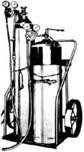
Oxygas cutting equipment can be stationary or portable. A portable oxygas outfit, such as the one shown in figure to a higher place, is an advantage when it is necessary to move the equipment from ane task to another.
To conduct your cutting requirements, y'all must be able to ready the cutting equipment and make the required adjustments needed to perform the cutting functioning. For this reason it is important y'all empathise the purpose and function of the basic pieces of equipment that make upward the cutting outfit. But, before discussing the equipment, let's expect at the gases nearly often used in cutting: acetylene, MAPP gas, and oxygen.
Acetylene
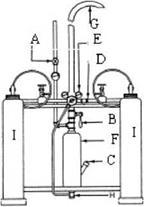
Acetylene is a flammable fuel gas equanimous of carbon and hydrogen having the chemical formula C2H2.When burned with oxygen, acetylene produces a hot flame, having a temperature between 5700°F and 6300°F. Acetylene is a colorless gas, having a disagreeable odor that is readily detected even when the gas is highly diluted with air. When a portable welding outfit, similar to the one shown in effigy above is used, acetylene is obtained straight from the cylinder. In the case of stationary equipment, similar to the acetylene cylinder bank shown in figure at right, the acetylene tin be piped to a number of private cut stations.
Hazards: Pure acetylene is self-explosive if stored in the complimentary state under a pressure of 29.4 pounds per square inch (psi). A slight shock is likely to crusade it to explode.
WARNING: Acetylene becomes extremely dangerous if used above 15 pounds pressure. A. Line valve E Regulator
B. Release valve F. Flash anestor
C. Filler plug sleeping accommodation
D. Header pipage 1000. Escape pipage
H. Check valve and drain, plug
I. Acetylene cyllmders
Cylinder Design
Acetylene can be safely compressed upward to 275 psi when dissolved in acetone and stored in especially designed cylinders filled with porous material, such as balsa wood, charcoal, finely shredded asbestos, corn pith, portland cement, or infusorial earth. These porous filler materials assist in the prevention of high-pressure gas pockets forming in the cylinder.
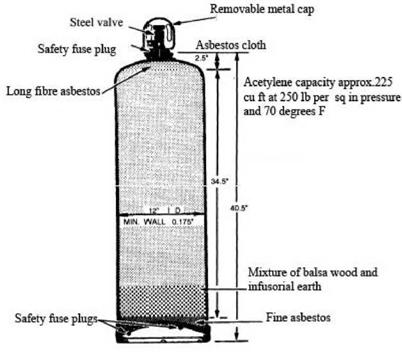
Acetone is a liquid chemical that dissolves large portions of acetylene under pressure without changing the nature of the gas. Existence a liquid, acetone can be drawn from an acetylene cylinder when it is not upright. You lot should not store acetylene cylinders on their side, but if they are, you must let the cylinder stand upright for a minimum of ii hours before using. This allows the acetone to settle to the bottom of the cylinder.
Notation: Acetone
contaminates the hoses, regulators, torch, and disrupts the flame.
Acetylene is measured in cubic feet. The most common cylinder sizes are 130-, 290-, and 330-cubic-human foot capacity. A common standard size cylinder holds 225 cubic feet of acetylene. Only because a cylinder has a 225-cubic-foot chapters does not necessarily hateful it has 225 cubic anxiety of acetylene in information technology.
Because information technology is dissolved in acetone, you lot cannot judge how much acetylene is
left in a cylinder by gauge pressure. The force per unit area of the acetylene cylinder will remain adequately abiding until virtually of the gas is consumed.
An example of an acetylene cylinder is shown in figure in a higher place. These cylinders are equipped with fusible plugs that relieve excess force per unit area if the cylinder is exposed to disengage heat. A common standard acetylene cylinder
contains 225 cubic feet of acetylene and weighs about 250 pounds. The
acetylene cylinder is yellowish, and all compressed-gas cylinders are color-
coded for identification. More on the color coding of cylinders is covered
subsequently in this lesson.
Mapp Gas
MAPP (methylacetylene-propadiene) is an all-purpose industrial fuel having the high-flame temperature of acetylene but has the handling characteristics of propane. Existence a liquid, MAPP is sold by the pound, rather than past the cubic foot, equally with acetylene. 1 cylinder containing 70 pounds of MAPP gas can accomplish the work of more than six and one-half 225- cubic-foot acetylene cylinders; therefore, lxx pounds of MAPP gas is equal to 1,500 cubic feet of acetylene.
Cylinder Design
Total weight for a MAPP cylinder, which has the aforementioned physical size every bit a 225-cubic-foot acetylene cylinder, is 120 pounds (70 pounds which is MAPP gas). MAPP cylinders comprise only liquid fuel. There is no cylinder packing or acetone to impair fuel withdrawal; therefore, the unabridged contents of a MAPP cylinder tin can exist used. For heavy-utilize situations, a MAPP cylinder delivers more than twice as much gas as an acetylene cylinder for the same time period.
MAPP Characteristics
Because of its superior heat transfer characteristics, MAPP produces a flame temperature of 5300°F when burned with oxygen. MAPP equals, or exceeds, the performance of acetylene for cutting, heating, and brazing. MAPP is not sensitive to daze and is nonflammable in the absenteeism of oxygen. There is no chance of an explosion if a cylinder is bumped, jarred, or dropped. Yous can store or transport the cylinders in whatever position with no danger of forming an explosive gas pocket. The characteristic odor, while harmless, gives warnings of fuel leaks in the equipment long earlier a dangerous status can occur. MAPP gas is not restricted to a maximum working pressure of 15 psig, as is acetylene. In jobs requiring higher pressures and gas flows, MAPP can exist used safely at the full-cylinder pressure of 95 psig at lxx°F. Considering of this, MAPP is an splendid gas for underwater work.
Bulk MAPP Gas
Bulk MAPP gas facilities, similar to liquid oxygen stations, are installed at some activities where large supplies of the gas are used. In majority installations, MAPP gas is delivered through a piping system directly to the user points. Maximum force per unit area is controlled centrally for efficiency and economy. Cylinder-filling facilities are likewise available from bulk installations that allow users to fill up their cylinders on site. Filling a 70-pound MAPP cylinder takes ane man about one infinitesimal and is substantially like pumping water from a big tank to a smaller one.
MAPP Gas Rubber
MAPP gas vapor is stable upward to 600°F and 1,100 psig when exposed to an 825°F probe. The explosive limits of MAPP gas are iii.4 pct to 10.8 pct in air or two.5 percent to fourscore percent in oxygen. As shown in figure iv-6, you tin can see these limits are narrow in comparison with that of acetylene. MAPP gas has a highly detectable odor. The olfactory property is detectable at 100 ppm, or at a concentration of 1/340th of its lower explosive limit. Small fuel-gas systems may leak 1 or 1 i/two pounds of fuel or more in an 8-hour shift; majority systems will leak even more. Fuel-gas leaks are oft difficult to observe and often get unnoticed; even so, a MAPP gas leak is easy to detect and tin be repaired before it becomes dangerous. MAPP toxicity is rated "very slight," only high concentrations (5,000 ppm) may have an coldhearted effect. Local centre or skin contact with MAPP gas vapor causes no adverse outcome; yet, the liquid fuel can cause dangerous frostlike burns due to the cooling caused past the rapid evaporation of the liquid. The identification markings on a MAPP cylinder are a yellow body with band "B" colored orange and the peak yellow.
Oxygen
Oxygen is a colorless, tasteless, and odorless gas and is slightly heavier than air. Information technology is nonflammable but supports combustion with other elements. In its free state, oxygen is ane of the more than common elements. The atmosphere is fabricated up of almost 21 parts of oxygen and 78 parts of nitrogen, the residual beingness rare gases. Rusting of ferrous metals, discoloration of copper, and corrosion of aluminum are all due to the activeness of atmospheric oxygen. This activity is known every bit oxidation. Oxygen is obtained commercially either by the liquid-air process or past the electrolytic process. In the liquid-air process, the air is compressed and then cooled to a point where the gases become liquid (approximately -375°F). The temperature is so raised to to a higher place -321 'F, at which point the nitrogen in the air becomes gas once more and is removed. When the temperature of the remaining liquid is raised to -297°F, the oxygen forms gas and is drawn off. The oxygen is further purified and compressed into cylinders for utilise. The other process past which oxygen is produced— the electrolytic procedure—consists of running an electric current through water to which an acid or an alkali has been added. The oxygen collects at the positive final and is drawn off through pipes to a container.
Oxygen is supplied for oxyacetylene welding in seamless steel cylinders. The color of a standard oxygen cylinder used for industrial purposes is solid green. Oxygen cylinders are made in several sizes. The size nearly often used in welding and cutting is the 244-cubic-human foot capacity cylinder. This cylinder is 9 inches in diameter, 51 inches high, and weighs about 145 pounds and is charged to a force per unit area of 2,200 psi at 70°F. You tin
determine the amount of oxygen in a compressed gas cylinder by reading the volume calibration on the loftier-pressure gauge attached to the regulator.
Regulators
You must be able to reduce the high-pressure gas in a cylinder to a working pressure earlier you tin use it. This force per unit area reduction is washed past a regulator or reducing valve. The one basic job of all regulators is to have the high-pressure gas from the cylinder and reduce information technology to a level that tin can exist safely used. Not but do they command the force per unit area only they also command the flow (book of gas per hour).
Regulators come up in all sizes and types. Some are designed for high - force per unit area oxygen cylinders (two,200 psig), while others are designed for low - pressure gases, such equally natural gas (5 psig). Some gases like nitrous oxide or carbon dioxide freeze when their pressure is reduced so they require electrically heated regulators.
Nearly regulators accept two gauges: one indicates the cylinder pressure level when the valve is opened and the other indicates the pressure of the gas coming out of the regulator. You must open up the regulator earlier y'all get a reading on the 2nd gauge. This is the delivery pressure of the gas, and you lot must set the force per unit area that you need for your particular job.
The pressures that you lot read on regulator gauges is called estimate force per unit area. If y'all are using pounds per square inch, it should exist written as psig (this acronym means pounds per square inch guess). When the judge on a cylinder reads zero, this does not mean that the cylinder is empty. In actuality, the cylinder is still full of gas, only the pressure is equal to the surrounding atmospheric pressure. Remember: no gas cylinder is empty unless it has been pumped out by a vacuum pump.
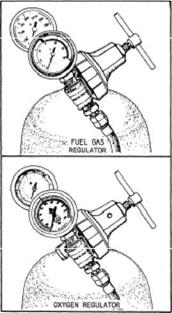
Single stage regulators
There are ii types of regulators that control the flow of gas from a cylinder. These are either single-stage or double-stage regulators.
Single-Stage Regulators Regulators are used on both high - and low-force per unit area systems. Figure at left shows two Unmarried-STAGE regulators: one for acetylene and one for oxygen. The regulator mechanism consists of a nozzle through which the gases pass, a valve seat to close off the nozzle, a diaphragm, and balancing springs. These mechanisms are all enclosed in a suitable housing. Fuel-gas regulators and oxygen regulators are basically the same blueprint. The
difference being those designed for fuel gases are non fabricated to withstand the loftier pressures that oxygen regulators are subjected to.
In the oxygen regulator, the oxygen enters through the high-pressure level inlet connection and passes through a glass wool stammer that removes grit and dirt. Turning the adjusting screw IN (clockwise) allows the oxygen to pass from the high-force per unit area chamber to the low-pressure chamber of the regulator, through the regulator outlet, and through the hose to the torch. Turning the adjusting screw farther clockwise increases the working pressure; turning it counterclockwise decreases the working pressure.
The high-pressure judge on an oxygen regulator is graduated from 0 to 3,000 psig and from 0 to 220 in cubic feet. This allows readings of the gauge
to determine cylinder pressure and cubic content. Gauges are calibrated to
read correctly at 70°F. The working pressure gauge may be graduated in "psig" from 0 to 150, 0 to 200, or from 0 to 400, depending upon the type of regulator used. For instance, on regulators designed for heavy cutting, the working pressure guess is graduated from 0 to 400.
The major disadvantage of single-stage regulators is that the working gas pressure you set will decrease as the cylinder pressure decreases; therefore, you must constantly monitor and reset the regulator if you require a fixed pressure and menstruation charge per unit. Keeping the gas force per unit area and menses rate abiding is too much to expect from a regulator that has to reduce the pressure level of a full
cylinder from 2,200 psig to v psig. This is where double-stage regulators
solve the trouble.
Working pressure guess '
"gratuitous floating"seat guide
second-stage,
mechanism
cylinder
pressure
gauge
inlet
first-stage machinery
diaphragm limiting device
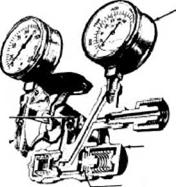
Double-Stage Regulators
The double-stage
regulator is similar in principle to the 1 - stage regulator.
The main
difference being that the total pressure drop takes identify in 2 stages instead of i. In the high-pressure level stage, the cylinder pressure is reduced to an intermediate pressure that was predetermined past the manufacturer. In the low-pressure stage, the pressure is again reduced from the intermediate
force per unit area to the working force per unit area you have chosen. A typical double-phase regulator is shown in figure higher up.
Bug And Safety
Regulators are precise and complicated pieces of equipment. Abandon can do more to ruin a regulator than any other gas-using equipment. 1 can hands damage a regulator by merely forgetting to wipe clean the cylinder, regulator, or hose connections. When you open a loftier - force per unit area cylinder, the gas can blitz into the regulator at the speed of sound. If there is any dirt nowadays in the connections, it will be blasted into the precision-fitted valve seats, causing them to leak. This results in a condition that is known every bit creep. Pitter-patter occurs when y'all shut of the regulator merely not the cylinder and gas pressure level is still being delivered to the low-pressure side.
Regulators are built with a minimum of two relief devices that protect you and the equipment in the instance of regulator creep or high-pressure gas being released into the regulator all at once. All regulator gauges have blowout backs that release the pressure from the back of the judge before the gauge glass explodes. Nowadays, most manufacturers utilise shatterproof plastic instead of drinking glass. The regulator body is also protected by safety devices. Blowout disks or jump-loaded relief valves are the two most common types of devices used. When a blowout deejay ruptures, information technology sounds like a cannon. Spring-loaded relief valves commonly make howling or shrieking similar noises. In either case, your start action, after you recover from your initial fright, should be to turn off the cylinder valve. Remove the regulator and tag information technology for repair or disposal. When opening a gas cylinder, you should just "crack" the valve a little. This should be done before attaching the regulator and every fourth dimension thereafter. By opening the cylinder before connecting the regulator, you lot blow out any dirt or other foreign fabric that might be in the cylinder nozzle. As well, there is the possibility of a regulator exploding if the cylinder valve is opened quickly.
WARNING: Oil or other petroleum products must never be used around oxygen regulators because these products will either crusade a regulator explosion or fire
Hoses
The hoses used to brand the connections between the torch and the regulators must be strong, nonporous, light, and flexible plenty to make torch movements easy. They must be made to withstand internal pressures that can accomplish equally high as 100 psig. The rubber used in hose manufacture is especially treated to remove the sulfur that could cause spontaneous combustion.
Welding hose is available in single - and double-hose lengths. Size is adamant by the inside diameter, and the proper size to use depends on the type of work for which it is intended. Hose used for calorie-free work has a 3/16 or 1/iv inch inside diameter and one or 2 plies of fabric. For heavy-duty welding and cutting operations, utilise a hose with an inside diameter of 5/16 inch and 3 to five plies of textile. Single hose is bachelor in the standard sizes besides as one/two-, 3/iv-, and one-inch sizes. These larger sizes are for heavy-
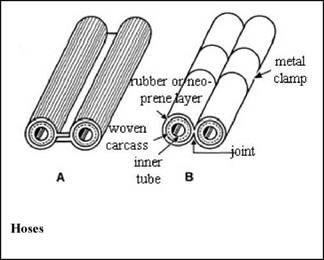
duty heating and for use on big cutting machines.
The most common blazon of cutting and welding hose is the twin or double hose that consists of the fuel hose and the oxygen hose joined together side by side. They are joined together by either a special rib or past clamps. Because they are joined together, the hoses are less likely to get tangled and are easier to move from place to place.
The length of hose you use is important. The commitment pressure at the torch varies with the length of the hose. A 20-foot, 3/xvi-inch hose maybe adequate for a job, only if the same hose was 50 feet long, the pressure drop would consequence in insufficient gas flow to the torch. Longer hoses require larger inside diameters to ensure the right flow of gas to the torch. When you are having bug welding or cutting, this is one area to check. The hoses used for fuel gas and oxygen are identical in structure, but they differ in color. The oxygen hose encompass is GREEN, and the fuel-gas hose embrace is Ruby. This color coding aids in the prevention of mishaps that could atomic number 82 to dangerous accidents.
All connections for welding and cut hoses have been standardized by the Compressed Gas Association. Letter grades A, B, C, D, and E plus the type of gas used correspond directly with the connections on the regulators. A, B, and C are the most common size connections. A-size is for depression-flow rates; B-size for medium-flow rates; and C-size is for heavy-flow rates. D and E sizes are for large cutting and heating torches.
When ordering connections, yous must specify the blazon of gas the hose volition be carrying. This is considering the connections will be threaded differently for unlike types of gas. Fuel gases utilise left-hand threads, while oxygen uses correct-hand threads. The reason for this is to foreclose the accidental hookup of
a fuel gas to a life-support oxygen organisation or vice versa. The basic hose connection consists of a nut and gland. The nut has threads on the within that match up with the male inlet and outlet on the torch and regulator. The gland slides inside the hose and is held in identify by a ferrule that has been crimped. The nut is loose and can be turned by manus or a wrench to tighten the threaded nut onto the equipment.
Another important item that is often overlooked is bank check valves. These inexpensive valves prevent personal injuries and salve valuable equipment from flashbacks. When ordering, make sure you specify the type of gas, connection size, and thread design. The check valves should be installed between the torch connexion and the hose.
Cutting Torches
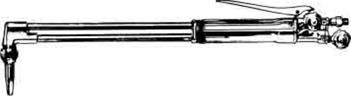
One piece oxygas cutting torch
The equipment and accessories for oxygas cutting are the aforementioned as for oxygas welding except that y'all use a cutting torch or a cutting attachment instead of a welding torch. The main difference between the cutting torch and the welding torch is that the cutting torch has an additional tube for high - pressure level cut oxygen. The flow of high-pressure oxygen is controlled from a valve on the handle of the cut torch. In the standard cutting torch, the valve may be in the form of a trigger assembly like the 1 in figure below. On about torches, the cutting oxygen mechanism is designed so the cutting oxygen can be turned on gradually. The gradual opening of the cutting oxygen valve is particularly helpful in operations, such as pigsty piercing and rivet cutting.
Torch Body About welding torches are designed so the torso of the torch tin have either welding tips or a cutting attachment. This blazon of torch is called a combination torch. The advantage of this type of torch is the ease in irresolute from the welding mode to the cut mode. In that location is no demand to disconnect the hoses; yous just unscrew the welding tip and so screw on the cut attachment. The loftier-pressure cutting oxygen is controlled by a lever on the torch handle, equally shown in figure beneath.
Cutting Torch Tips
As in welding, you must use the proper size cutting tip if quality piece of work is to exist done. The preheat flames must furnish just the right corporeality of heat, and the oxygen jet orifice must deliver the right corporeality of oxygen at only the
right pressure and velocity to produce a clean cutting. All of this must exist done with a minimum consumption of oxygen and fuel gases. Devil-may-care workers and workers non acquainted with the correct procedures waste both oxygen and fuel gas.


Combination torch
Each manufacturer makes many dissimilar types of cutting tips. Although the orifice arrangements and the tips are much the same amongst the manufacturers, the part of the tip that fits into the torch head often differs in blueprint.
Considering of these differences, there is the possibility of having 2 or three different types of cutting torches in your kits. Make certain that the cutting tips match the cutting attachment and ensure that the cutting attachment matches the torch trunk. Figure in a higher place shows the dissimilar styles of tips, their orifice arrangements and their uses. The tips and sears are designed to produce an fifty-fifty period of gas and to continue themselves as absurd as possible. The seats must produce leakproof joints. If the joints leak, the preheat gases could mix with the cut oxygen or escape to the atmosphere, resulting in poor cuts or the possibility of flashbacks.
To brand clean and economical cuts, you must go along the tip orifices and passages clean and gratuitous of burrs and slag. If the tips become muddy or misshapened, they should exist put aside for restoration.
Tip Maintenance
In cutting operations, the stream of cut oxygen sometimes blows slag and molten metal into the tip orifices which partially clogs them. When this happens, you should clean the orifices thoroughly before you employ the tip again. A small-scale amount of slag or metal in an orifice will seriously interfere with the cutting operation. You should follow the recommendations of the torch manufacturer as to the size of drill or tip cleaner to utilize for cleaning the orifices. If you do not have a tip cleaner or drill, yous may use a piece of soft copper wire. Do not use twist drills, nails, or welding rods for cleaning tips because these items are likely to enlarge and distort the orifices.
Clean the orifices of the cutting torch tip in the same manner equally the single orifice of the welding torch tip. Remember: the proper technique for cleaning the tips is to push the cleaner direct in and out of the orifice. Exist careful non to plow or twist the cleaning wire. Effigy above shows a typical prepare of tip cleaners.
Occasionally the cleaning of the tips causes enlargement and distortion of the orifices, even when using the proper tip cleaners. If the orifices get enlarged, y'all will go shorter and thicker preheating flames; in addition, the jet of cutting oxygen will spread, rather than leave the torch, in the form of a long, thin stream. If the orifices become belled for a curt distance at the terminate, yous can sometimes right this by rubbing the tip back and forth against emery cloth placed on a apartment surface. This action wears down the terminate of the tip where the orifices have been belled, thus bringing the orifices back to their original size.
Obviously, this procedure will not work if the damage is not bad or if the belling extends more than than a slight distance into the orifice. After reconditioning a tip, you may test it by lighting the torch and observing the preheating flames. If the flames are too curt, the orifices are still partially blocked. If the flames snap out when you close the valves, the orifices are still distorted.
If the tip seat is muddy or scaled and does not properly fit into the torch caput, heat the tip to a deadening ruddy and quench it in water. This will loosen the calibration and dirt plenty so you lot can rub it off with a soft fabric.
Speaking
True or simulated?
1. Oxygas cutting outfit and cutting rig are different things.
2. A gang wrench is used to light the torch.
3. Acetone has a favourable consequence on the cutting equipment.
4. The acetylene cylinder is painted bluish.
5. MAPP is a very toxic gas.
vi. Acetone is a solid body that dissolves large portions of acetylene under force per unit area.
vii. Cylinder valve should exist opened slowly to preclude explosion.
8. Local center or skin contact with MAPP liquid fuel gas tin can cause unsafe frostlike burns.
9. Twist drills, nails, or welding rods must not exist used for cleaning tips.
Continue the following sentences:
1. An oxygas cutting outfit ordinarily includes... .
two. The auxiliary cutting equipment may consist of ... .
3. Acetylene is a flammable fuel gas that has the following characteristics: ...
4. Acetone is a liquid chemic that.
5. MAPP is characterized by...
half-dozen. The action of atmospheric oxygen, oxidation, manifests itself in...
7. Personal safe clothes for welders involved in cut operation include... 8. The hoses that connect the torch and the regulators must exist... .
Translate the following sentences into English:
1. Для правильного использования сварочной аппаратуры сварщик должен знать назначение и функции ее основных узлов.
2. Для обеспечения безопасности перед началом работы необходимо довести давление газа до рабочего и отрегулировать пламя.
3. Перед присоединением регулятора к цилиндру необходимо удалить с сопла цилиндра пыль и другие инородные материалы.
4. Редукторы давления выпускаются различных типов и размеров, как для цилиндров высокого, так и низкого давления.
5. Для предотвращения случайной подачи топливного газа к кислородной системе и наоборот используются соединения с разным направлением резьбы.
half-dozen. При засорении сопла резака пламя предварительного нагрева расширяется.
seven. Соприкосновение редуктора давления с нефтепродуктами может вызвать взрыв или возгорание последнего.
viii. По своим рабочим характеристикам метилацетилен-аллен превосходит ацетилен при резке, подогреве либо пайке.
9. Редукторы давления требуют тщательного ухода.
10. Шланги для подачи горючего газа и кислорода маркируются разными цветами и чаще всего скрепляются вместе для предотвращения спутывания.
11. Баллон с газом не может считаться пустым, пока газ не будет откачан насосом.
Compare operating characteristics of acetylene and MAPP gas according to some of the parameters and fill in the table below:
| Acetylene | MAPP | |
| The gas is sold past (pounds or cubic meters) |
| Cylinder packing (level of maximum pinch) | ||
| Stability (temperature) | ||
| Cylinders contain (pure fuel or not) | ||
| Dangerous furnishings on health |
Reading
Skim the text and do the tasks:
Взять все проблемы клиента на себя - основной секрет 15 летнего успешного роста от masterperevoda.ru
Владение иностранными языками — это возможность открыть множество вариантов самореализации и достичь больших успехов. Наиболее универсальным является английский язык, которым владеет подавляющее большинство людей во всем мире. Это уникальный язык …
Таблица 1. Классификация сварки металлов по ГОСТ 19521-74 Класс сварки Определение Вид сварки Термический Виды сварки, осуществляемы плавлением с использованием тепловой энергии дуговая, электрошлаковая, электронно-лучевая, плазменно-лучевая, ионно-лучевая, тлеющим разрядом, световая, …
laycockbuiribithe.blogspot.com
Source: https://msd.com.ua/anglijskij-dlya-svarshhikov/oxygas-cutting-equipment/
0 Response to "The Pressure Produced by 10 Feet Head of Water Is Equal to a Gauge Pressure Reading of ______ Psi"
Post a Comment